“This is the latest,” said Crake.
What they were looking at was a large bulblike object that seemed to be covered with stippled whitish-yellow skin. Out of it came twenty thick fleshy tubes, and at the end of each tube another bulb was growing.
“What the hell is it?” said Jimmy.
“Those are chickens,” said Crake. “Chicken parts. Just the breasts, on this one. They’ve got ones that specialize in drumsticks too, twelve to a growth unit.
“But there aren’t any heads…”
“That’s the head in the middle,” said the woman. “There’s a mouth opening at the top, they dump nutrients in there. No eyes or beak or anything, they don’t need those.”
Margret Atwood (2003) Oryx and Crake
“No brain, no pain!” reads the fridge magnet on Crake’s fridge in Margret Atwood’s dystopian novel ‘Oryx and Crake’ (Atwood, 2003).
This slogan suggests that to remove all physical sensations such as pain, consciousness and movement from animals is to remove the ethical and moral dilemmas posed by the food industry. And to complete this genetic modification and maximise output, why not remove any superfluous anatomy and make each ‘chicken’ produce 12 drumsticks or 20 breasts? The result being ChickieNobs, a comatose chicken-like creature.

Jimmy, the protagonist of Atwood’s series is repulsed by the idea of this genetically modified meat voicing that “it would be like eating a large wart” (Atwood, 2003). However, throughout the series Jimmy begins to regularly eat ChickieNobs Buckets O’ Nubbins due to the high prices and unavailability of regular meat.
This thought experiment raises important questions surrounding the importance of pain in the ethical treatment of animals but also more broadly, the morality of meat-eating and the ethical dilemmas surrounding the immanent rise of the artificial meat industry.
The consequence of animal suffering has been present in Western philosophical discourse since Antiquity (Franco, 2013). It is important to consider this in order to provide historical context around this issue as well as to understand the current paradigm of the acceptable uses of animals.

Descartes was a fundamental figure in developing the philosophical basis for science and enlightenment. He sought the certainty of knowledge by doubting everything, including his own body and the existence of the world (Descartes, 1984). In his famous statement ‘I think therefore I am’ he deduced that he is a ‘thinking mind’ and his ability to think was the only thing that he could not doubt as doubting is a form of thinking. He argued that if he could doubt the existence of his body and the external world then he could exist without them. Mind and body must exist in separation to each other, forming the foundation the common conceptualisation of mind and the body in the West in dualistic, oppositional terms. To Descartes, animals were not conscious, did not have minds, and therefore did not experience pain. He viewed them as complex machines or ‘automata’. Although he was heavily criticised by his contemporaries, this formed a defence and moral justification for the treatment of animals for centuries (Franco, 2013).
Opposition to the treatment of animals as machines or beings to be used for the benefit of humans became more prevalent at the beginning of the eighteenth century from many influential philosophers. Bentham argued that animal suffering was morally concerning, implicating meat consumption (Bentham, 1843).
“The question is not, Can they reason? nor, Can they talk? but, Can they suffer?”
Bentham Jeremy (1823) An Introduction to the Principles of Morals and Legislation.
This philosophical paradigm shift acknowledges the sentience and ability of animals to have complex emotional lives. Meat consumption could no longer be justified because animals lack these characteristics.
ChickieNubs raise an interesting question of whether removing the mind of the chicken to leave only the body can de-problematise the ethics of meat production. This creates a ultra-Cartesian dualism where body and mind are forcibly separated.

Of course, animal cruelty and the ethical argument is only one of the many reasons why people may decide to cut out meat from their diets, however, it remains a key factor in many people’s decisions to go vegan or vegetarian. The huge rise in recent years in the number of vegetarians and vegans coupled with the detrimental environmental costs of raising livestock has increased the demand for meat-free products. Recent products such as Gregg’s vegan sausage roll, made of mycoprotein and ‘free of animal cruelty’, have proved a hit with customers (Scott, 2019).
So how can capitalist industries deal with this growing demand for meat-like products, solve the environmental dilemma, and avoid cruelty to animals? Many scientists are turning to the possibility of growing meat.
Lab-grown meat is made by growing muscle cells in a nutrient-serum and forming them into muscle-like fibres, mimicking the texture of ‘real’ meat (Ireland, 2019). Satellite cells are obtained from a small sample of muscle taken from a live animal. These can then be turned into the different cells found in muscle which are then duplicated within a nutrient serum. One cell could in theory be used to grow infinite meat, radically reducing the ethical controversies of meat production and theoretically solving food insecurity.
As explored in my last blog post ‘home’, food is made tasty by reproducing biographies and memories through the sensory experience of eating it. To make successful products, the artificial meat industry must recreate this familiar ‘taste-texture-aroma’. By making the meat culturally familiar, production companies can make the food ‘good to think’ with. The technical processes of achieving this seem to be fairly easy for researchers to achieve as they are able to manipulate the chemicals in order to achieve good flavour (Cadwalladr, 2014). Upon comments by critics on the dryness of an early sample burger, cultured meat companies began working on culturing fat cells and tissues from cows to mix with the muscle fibres.
Laboratory-grown meat using tissue engineering techniques could generate up to 97% lower greenhouse gas emissions: requiring radically less water and land area to create, reducing transportation, and producing less waste products (Ox.ac.uk, 2011). Artificial meat is “meat without the murder” (Cadwalladr, 2014) . However, the question remains of whether people would eat it? In a survey conducted by The Guardian, 69% of people were willing to eat meat grown in a lab (The Guardian, 2013).
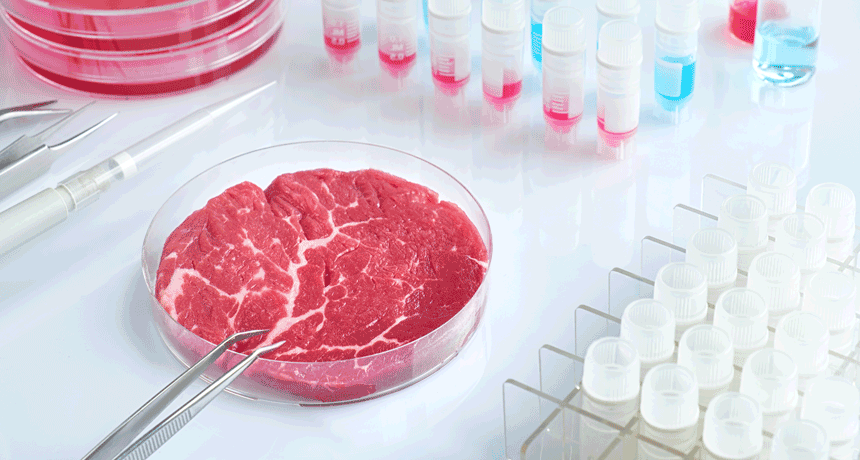
The development of artificially grown meat is as much a philosophical hurdle as it is a technological one (Cadwalladr, 2014). People find it hard to imagine that the meat-like product of a laboratory could be as delicious as an actual animal. Many people balance between the gut-feeling of object to it and the rational acceptance that the product may be ethically, environmentally, and economically right. This has been deemed as the ‘yuck factor’ (George, 2012). Perhaps this is the ‘uncanny valley’ : that as artificial meat appears more meat-like, it will become more appealing, but once it’s resemblance passes a certain point it will elicit revulsion.
It is these cultural, philosophical, and ethical biases which elicit inherent repulsion from many people. The idea of food being ‘good’ is embedded within cultural traditions of what tastes good and what is culturally accepted. On the other hand, production companies are also using and manipulating these biases to help sell their products. By presenting the meat as both ‘good to eat’ (as it mimics the exact taste-texture-aroma of meat) and ‘good to think’ with (as it is ethically superior), will these research laboratories be able to produce ‘good’ food? (Lévi-Strauss, 1991). After all, when analysed under a microscope, artificial meat will look exactly the same as traditional meat (Cadwalladr, 2014). Scientists are working to ensure that it looks, tastes and smells exactly like the ‘real thing’. So, when lab-grown meat becomes a real choice on our supermarket shelves, how are people going to justify refusing to eat it?
As Jimmy from Attwood’s novel argued: “as with the tit implants– the good ones– maybe he wouldn’t be able to tell the difference” (Atwood, 2003).
Bibliography
Atwood, Margret. (2003). Oryx and Crake. New York: Anchor.
Bentham, Jeremy (1823) An Introduction to the Principles of Morals and Legislation. London: W. Pickering.
Bentham, Jeremy (1843) Anarchical fallacies: Being an examination of the declarations of rights issued during the french revolution. In: Bowring J., editor. The Works of Jeremy Bentham. London: William Tate.
Cadwalladr, Carole (2014). Laboratory-grown beef: meat without the murder, but would you eat it?. [online] The Guardian. Available at: https://www.theguardian.com/science/2014/jul/13/laboratory-grown-beef-meat-without-murder-hunger-climate-change [Accessed 25 Feb. 2020].
Descartes, René., (1984) The Philosophical Writings of Descartes. Cambridge: Cambridge University Press.
Franco, Nuno Henrique (2013) Animal Experiments in Biomedical Research: A Historical Perspective. Animals : an open access journal from MDPI 3(1) 238-73 doi:10.3390/ani3010238
Geneticsandliterature.files.wordpress.com. (2012). [image] ChickieNobs vs. God’s Gardeners: Meat Production and Consumption. Available at: https://geneticsandliterature.files.wordpress.com/2012/03/engl-243-chickienob1.jpg?w=584 [Accessed 25 Feb. 2020].
George, Alison. (2012). The yuck factor: The surprising power of disgust. [online] New Scientist. Available at: https://www.newscientist.com/article/mg21528731-800-the-yuck-factor-the-surprising-power-of-disgust/ [Accessed 25 Feb. 2020].
Ireland, Tom. (2019). The artificial meat factory – the science of your synthetic supper. [online] BBC Science Focus Magazine. Available at: https://www.sciencefocus.com/future-technology/the-artificial-meat-factory-the-science-of-your-synthetic-supper/ [Accessed 25 Feb. 2020].
Lévi-Strauss, C. (1991) Totemism. London: Merlin Press.
Mori, Masohiro; MacDorman, Karl F.; Kageki, Norri (2012) The Uncanny Valley [From the Field], IEEE Robotics & Automation Magazine, 19 (2):98-100.
Ox.ac.uk. (2011). Lab-grown meat would ‘cut emissions and save energy’ | University of Oxford. [online] Available at: http://www.ox.ac.uk/news/2011-06-21-lab-grown-meat-would-cut-emissions-and-save-energy# [Accessed 25 Feb. 2020].
RSPCA (n.d.). Laying hens – key welfare issues [image] Available at: https://www.rspca.org.uk/adviceandwelfare/farm/layinghens/keyissues [Accessed 25 Feb. 2020]
Science News for Students (2019). [image] Available at: https://www.sciencenewsforstudents.org/article/new-spin-lab-grown-meat [Accessed 25 Feb. 2020].
Scott, Ellen. (2019). Greggs vegan sausage roll ingredients and how many calories is it? | Metro News. [online] Metro.co.uk. Available at: https://metro.co.uk/2019/01/03/actually-greggs-vegan-sausage-roll-8305542/ [Accessed 25 Feb. 2020].
The Guardian. (2013). Would you eat lab-grown meat?. [online] Available at: https://www.theguardian.com/science/poll/2013/aug/05/stem-cells-meat-industry [Accessed 25 Feb. 2020].
The Independent (2019). [image] Available at: https://www.independent.co.uk/life-style/food-and-drink/greggs-vegan-sausage-roll-review-cronut-a9194651.html [Accessed 25 Feb. 2020].
 Food for Thought