Can you taste an image?
To begin to talk about the depiction of food in Japanese art, I will start (seemingly tangentially) with a discussion of the development of the printing industry in the Edo period (1603-1868). The growth of printing did not rely on technological developments, but on the rise of an urban consumer market to financially support it (Rath, 2010). Indeed, Japanese publishers continued to use the traditional method of woodblocks for printing.
As early as 1640 there were as many as hundred bookstores in Kyoto and it is estimated that Japan published an average of three thousand books a year. These books could cost the equivalent of a few meals up to the equivalent of a month’s worth of food. However, customers who could not afford to buy books could rent them from rental libraries, making them widely financially accessible.
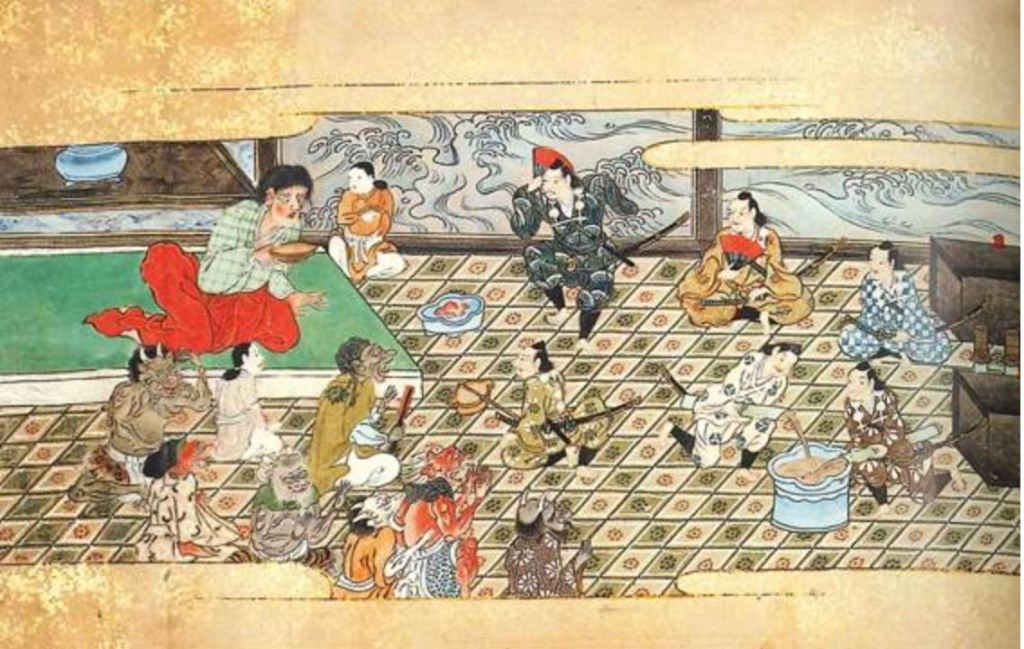
Some bookstores specialised in culinary books- collections of recipes and menus. Culinary books published during the early Edo period detailed elite styles of banqueting, allowing common people to learn about elite cuisine. Elite customs like shikisankon even became popular parts of lower-class weddings.
Although these culinary books allowed a wider appreciation of elite cuisine, there were heavy restrictions controlling accessibility to these forms of culture. The Tokugawa bakufu subdivided sections of society which reflected geographical differences. Laws enforced upon these categories specified aspects of daily life such as proper clothing, the size and location of one’s home, and mundane objects. Food and dining were also regulated and commoners could not legally serve special recipes reserved for Samurai or consume many game birds used in elite banquets.
Many of the banquets and menus detailed in culinary books could only be legally consumed by senior members of the bakufu and aristocrats. The cost of the ingredients also limited their audience. However, the publication of these culinary books exceeded the small number of people who could consume the foods described. Thus, it is difficult to draw a line between the readers who read for practicality and those who read for amusement.
So why did the lower class read about these foods they had no chance of ever preparing or consuming?
It is because they could fantasise about tasting swan sashimi with miso dressing, or attending a banquet fit for a shogun. The inaccessibility of these foods made them even more captivating. The publication of culinary texts allowed people to think about food as an imaginative, artistic, and intellectual practice. Food in Japan increasingly became a way to signify ideas, emotions, and sociality.
Evidently vivid descriptions and depictions of food through art and literature have formed a traditional part of Japanese entertainment. This may have provided a basis for the distinct way that food is portrayed in art in Japan today. I will explore this using anime and more specifically Studio Ghibli films as a case study.
Studio Ghibli films are a multi-sensory experience guiding you through stories of forest spirits, sassy talking cats, dragons, steampunk machines, vengeful gods, and magic. Their films are also famous for making their viewers hungry through their highly intimate portrayals of cooking and food (Cafolla, 2017). The characters in fantastical other-dimensions are fed on a wide variety of delicious-looking food ranging from the mundane such as bento boxes, onigiri, sandwiches and pasta, to the extraordinary such as lavish banquets.
“Anime may depict fictional worlds, but I nonetheless believe that at its core it must have a certain realism. Even if the world depicted is a lie, the trick is to make it seem as real as possible. Stated another way, the animator must fabricate a lie that seems so real, viewers will think the world depicted might possible exist.”
Hayao Miyazaki, co-founder of the Studio Ghibli animation studio (Miyazaki, 2014)
The fantastical worlds depicted are so rich in detail that they edge on reality. Studio Ghibli cuisine is made to look so real in part through the detail that goes into its images. Vivid details such as the slow dripping of honey from a jar in Ponyo (2008), the spitting of the bacon and eggs in the pan in Howl’s Moving Castle (1997), or the glistening of the soup dumplings in Spirited Away (2001) stimulate viewers to feel like they can taste and smell the food.
Ghibli worlds also bridge reality and fantasy through the incorporation of classic Japanese culture (Thuthao Keng Dam, n.d.). Washoku, ‘Japanese indigenous food culture’ is a UNESCO protected heritage practice which is deeply connected with social practices (Ich.unesco.org, 2013). Food in Japan is an expression of identity, family, and state (Stalker, 2019). The films depict Japanese dishes such as bento boxes, widespread practices of eating such as family meals, and a love for fresh produce, cooking, and shopping which is ingrained in traditional cuisine. Some of the films’ most emotive moments occur over food (Cafolla, 2017). In Spirited Away (2001), the main character Chihiro must eat food else she is warned she will disappear. Food is not only used to revitalise characters but also to build friendships, In Princess Mononoke (1997), San, a girl raised by wolves, chews food to feed to Prince Ashitaka who weak after suffering a shot attempting to save her. This moment of compassion not only builds the friendship between San and Prince Ashitaka but also breaks down the barrier between San and the human world. Thus, food and sharing food is an everyday reality which is intimately connected to the notion of being human in Japan.
These foods seem fantastically out of reach but simultaneously within the realms of possibility. This is reminiscent of the vivid depictions and descriptions of food within the culinary books of the early Edo period. Viewers are left craving dishes that they may never have tasted before (and may never get the opportunity to eat). It is this inaccessibility, the fantastical quality of Japanese food, that makes these dishes so deliciously tempting. Through the details with which these dishes are portrayed, these images not only capture our attention and our imagination but also create an intense sensory experience.
Perhaps this points to there being something distinctly Japanese about the portrayal of food in a way which bridges fantasy and reality, leaving consumers simultaneously hungry and satisfied.
Bibliography
Cafolla, Anna. (2017) All The Studio Ghibli Food We’D Love To Eat & What It Means. [online] Dazed. Available at: <https://www.dazeddigital.com/artsandculture/article/36294/1/all-the-studio-ghibli-food-wed-love-to-eat-what-it-means> [Accessed 23 August 2020].
Howl’s Moving Castle. (2004). [Online]. Directed by Hayao Miyazaki. Japan: Studio Ghibli [23/08/2020}. Netflix
Ich.unesco.org. (2013) UNESCO – Washoku, Traditional Dietary Cultures Of The Japanese, Notably For The Celebration Of New Year. [online] Available at: <https://ich.unesco.org/en/RL/washoku-traditional-dietary-cultures-of-the-japanese-notably-for-the-celebration-of-new-year-00869> [Accessed 23 August 2020].
Miyazaki, Hayao (2009) Starting Point and Turning Point. Viz Media, Subs. of Shogakukan Inc
Ponyo. (2008). [Online]. Directed by Hayao Miyazaki. Japan: Studio Ghibli [23/08/2020}. Netflix.
Princess Mononoke. (1997). [Online]. Directed by Hayao Miyazaki. Japan: Studio Ghibli [23/08/2020}. Netflix.
Rath, Eric C. (2010) Food and Fantasy in Early Modern Japan. Los Angeles, University of California Press.
Spirited Away. (2001). [Online]. Directed by Hayao Miyazaki. Japan: Studio Ghibli [23/08/2020}. Netflix.
Stalker, Nancy K. (2018) Devouring Japan: Global Perspectives on Japanese Culinary Identity. Oxford, Oxford University Press.
The Tokugawa Art Museum (2008). Momoyama-Edo Kaiga no Bi. Nagoya: The Tokugawa Art Museum.
Thuthao Keng Dam, Ashley. (n.d) Animating The Alimentary – The New Gastronome. [online] The New Gastronome. Available at: <https://thenewgastronome.com/animating-the-alimentary/> [Accessed 23 August 2020].
 Food for Thought